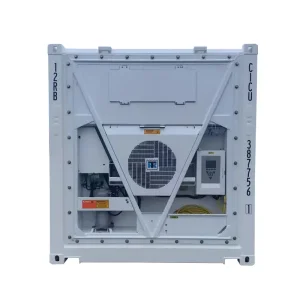
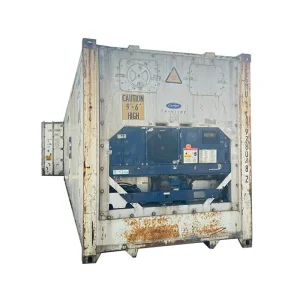
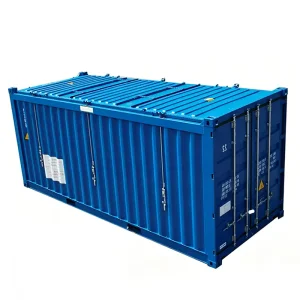
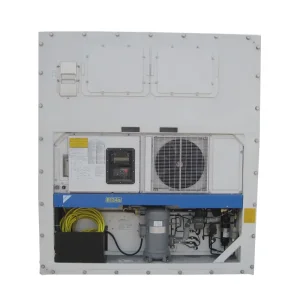
20ft Offshore Refrigerated Container for North Sea Fleet Logistics
- Temp range: -30°C to +30°C
- DNV 2.7-1 / EN 12079 / ISO 10855
- Integrated 4-point certified lifting sling
Verified configurations engineered to endure North Sea shock loads, dynamic wave impact, and rigorous ATEX/DNV maritime compliance.
Denmark occupies a pivotal position in maritime engineering, functioning both as the epicenter of Northern Europe's offshore wind industry and as the operational command center for key North Sea energy fields such as the Dan, Gorm, and Tyra complexes. The port of Esbjerg serves as Denmark's premier offshore logistics hub, orchestrating hundreds of monthly vessel calls that deliver equipment, chemicals, food rations, and technical instrumentation to offshore platforms and offshore wind farms (including Horns Rev and Kriegers Flak). Because dynamic wave accelerations and heavy marine storms are endemic to the North Sea, logistics managers cannot utilize standard ISO shipping reefers on supply boats. Transporting temperature-sensitive goods across these waters necessitates specialized Offshore Reefer Containers built strictly to DNV 2.7-1 (ISO 10855) and EN 12079 structural criteria.
Beyond traditional oil and gas fields, the accelerated deployment of offshore wind turbine platforms demands extended offshore catering and cold storage capabilities. Commissioning crews and Service Operation Vessels (SOVs) require refrigerated containerized solutions capable of preserving perishable foodstuffs, delicate chemical grouting materials, and specialized resin systems under stable temperatures between -30°C and +10°C, regardless of external ambient shifts or saltwater exposure. Concurrently, Danish ports such as Aarhus, Hirtshals, and Frederikshavn function as core logistics gateways handling high-value pelagic fish catches and farmed Atlantic salmon transiting from the Faroe Islands and Greenland. Sourcing certified offshore refrigerated containers with precise temperature tracking and maximum operational reliability has evolved into a strategic imperative for Danish maritime operators.
"Offshore operations in the Danish sector of the North Sea tolerate zero margin for structural failure. Every container lifted from supply vessels to substations or offshore rigs must withstand dynamic impact shocks of multiple G-forces at -20°C ambient temperatures while maintaining hermetic thermal boundaries."
Unlike standard ISO cargo containers, offshore reefers operating out of Danish ports must endure extreme dynamic loading. Every unit integrates certified padeyes, heavy-gauge corner posts, and pre-rigged 4-leg wire rope slings with safety shackles.
For installations in Zone 1 or Zone 2 hazardous operating environments aboard drilling rigs and floating production storage and offloading (FPSO) units, electrical and compressor housings are spark-proofed to mitigate gas blowout hazards.
North Sea brine induces rapid oxidation. Our units receive specialized blast cleaning to ISO Sa 2.5 standards followed by multi-coat epoxy zinc primers and marine polyurethane topcoats engineered for 15+ years of operational resilience.
While Denmark is globally revered for offshore logistics planning and vessel operations, domestic manufacturing of heavy offshore steel structures faces severe labor capacity constraints and inflated production overheads. Danish engineering contractors, rig operators, and vessel charterers gain decisive competitive advantages by purchasing directly from our high-precision heavy container manufacturing complex in Tianjin, China. Situated directly adjacent to major deep-water ports, our facility combines four decades of structural metallurgy with seamless access to tier-1 refrigeration machinery, delivering units that meet or exceed European standards at optimal capital expenditure.
Our direct manufacturing model eliminates multiple distribution markups common in local European broker channels while providing one-to-one design consultation with specialized naval and offshore structural engineers. Every batch produced for Danish buyers undergoes strict quality assurance protocols witnessed by third-party classification societies (DNV, Bureau Veritas, Lloyd's Register). From structural impact testing at -20°C to full PTI (Pre-Trip Inspection) thermal cycle logging, we guarantee that every offshore reefer container arrives at Esbjerg or Aarhus certified and ready for immediate deployment.
1. Corten SPA-H Structural Steel: We exclusively utilize high-yield Corten atmospheric corrosion-resistant steel for corner castings, load-bearing rails, and structural headers. This material forms a protective patina when exposed to maritime air, preventing structural degradation.
2. Robotized Submerged Arc Welding: Critical structural joints, lifting padeyes, and base frames undergo continuous automated welding. 100% of padeyes receive Non-Destructive Testing (NDT) including Magnetic Particle Inspection (MPI) and Ultrasonic Testing (UT).
3. Seamless Tier-1 Refrigeration Integration: We maintain direct strategic supply partnerships with Carrier Transicold, Thermo King, and Daikin, ensuring our units are powered by state-of-the-art scroll compressors with automated microprocessors and eco-friendly refrigerants.
4. High-Density Pressure Foaming: The thermal envelope features high-pressure cyclopentane-blown polyurethane insulation (density 42-45 kg/m³), eradicating thermal bridges and slashing auxiliary diesel generator fuel consumption on offshore supply vessels.

| Technical Parameter | Standard ISO Reefer Container | Our DNV 2.7-1 Offshore Reefer (Denmark Delivery) |
|---|---|---|
| Structural Standards | ISO 1496-2 / CSC Only | DNV 2.7-1 / EN 12079 / ISO 10855 / IMO Circular 860 |
| Operating Temperature Ambient | -10°C to +38°C (Standard Shipping) | -20°C to +45°C (Extreme Maritime & Arctic North Sea Grade) |
| Lifting Rigging System | Standard spreader twistlocks | Integrated 4-Point High-Tensile Slings & Shackles with Proof Load Testing |
| Structural Steel Shell | Standard mild carbon steel (1.6 - 2.0 mm) | Heavy-gauge SPA-H Corten Steel (3.0 - 4.5 mm) with reinforced corner pillars |
| Corrosion Protection | Standard C3 maritime paint (120-150 µm) | ISO 12944 C5-M High Durability Offshore System (280-320 µm total DFT) |
| Explosion-Proof Options | Not available | ATEX Zone 1 / Zone 2 certified electrical controls & emergency cutoff |
| Interior Cladding | Standard stainless steel 304 lining | Heavy-duty Food-Grade SS304 / SS316 with continuous T-bar drainage floor |
From remote wind farm service operations to North Sea oil revitalization and Nordic pelagic supply chains.
Offshore wind farms off Denmark's coast require Service Operation Vessels (SOVs) and walk-to-work crews deployed for weeks at sea. Our offshore reefers provide constant chilled sustenance storage, precision cooling for hydraulic oils, and secure thermal preservation for specialized turbine composite repair resins.
The extensive redevelopment of Denmark's Tyra natural gas field relies on seamless supply runs out of Esbjerg. Certified DNV 2.7-1 refrigerated modules carry fresh and frozen galley supplies from mainland food contractors straight to rig living quarters without double-handling cargo.
Ports in northern Jutland receive massive volumes of North Atlantic cod, haddock, mackerel, and Greenland halibut. Our deep-freeze reefers operate at sustained -30°C to -40°C thresholds to preserve cellular texture and nutritional integrity prior to processing in Danish packing facilities.
The offshore container manufacturing sector is transitioning through an era of rapid technological digitalization and green compliance. Driven by European Union environmental directives and Danish maritime decarbonization roadmaps, industrial buyers demand more than passive cold containment. Today's offshore reefers represent complex thermodynamic systems embedded with digital telematics, remote diagnostics, and energy-conserving propulsion synergy.
1. Satellite-Enabled IoT Telematics & Remote Condition Monitoring: In the open North Sea, cellular connectivity is frequently unavailable. Our premium offshore reefers can be equipped with dual GSM and Iridium satellite modems. Logistics personnel stationed in Copenhagen or Esbjerg can monitor internal temperatures, compressor run hours, defrost frequency, and door openings in real time, automatically triggering alarm alerts if internal parameters drift outside preset thresholds.
2. Eco-Friendly, Low-GWP Refrigerant Adoption: With tighter F-gas regulations taking effect across Denmark and the EU, traditional hydrofluorocarbon (HFC) refrigerants like R-404A are phased out in favor of low Global Warming Potential (GWP) alternatives such as R-452A, R-513A, and non-flammable natural CO₂ (R-744) transcritical refrigeration circuits. These coolants drop carbon impact substantially while improving coefficient of performance (COP) in freezing modes.
3. Cold Ironing and Shore-Power Direct Integration: Modern Danish maritime ports are aggressively investing in shoreside electrical infrastructure to eliminate vessel diesel emissions during dock loading. Our container cooling units are optimized with multi-voltage frequency drives (380V-460V, 50/60Hz) capable of direct hook-up to both quayside shore grids and offshore platform auxiliary power networks.
Algorithms monitor evaporator coil pressure differentials, initiating defrost heating strictly when ice accumulates. This eliminates unnecessary thermal spikes and reduces energy usage by up to 28%.
Precision polyamide thermal decoupling gaskets between the external Corten structural frame and the stainless internal lining prevent sweating, frost buildup, and cold conduction losses.
All-aluminum micro-channel condenser coils boost heat transfer efficiency, lower refrigerant charge requirements by 30%, and resist galvanic corrosion caused by airborne sea salt.
Navigating the procurement of offshore refrigerated containers demands rigorous verification of regulatory compliance, structural testing credentials, and cold-chain integrity. When sourcing directly from China to European discharge ports such as Aarhus, Copenhagen, or Esbjerg, offshore supply managers must verify that manufacturers fulfill the following engineering protocols:
| Verification Pillar | Mandatory Criteria for Denmark & North Sea Deployments | Manufacturer Certification Method |
|---|---|---|
| 1. Classification Approval | DNV-GL Type Approval Certificate or Case-by-Case Design Appraisal according to DNV 2.7-1 / ISO 10855. | Factory stamping, DNV data plate, and hardcopy certificate package delivered with each container. |
| 2. Steel Traceability | EN 10204 3.1 Material Test Reports (MTR) demonstrating Charpy V-notch impact values >= 27 Joules at -20°C (or -40°C for Arctic operations). | Mill test documentation matching physical heat numbers stamped into structural members. |
| 3. Lifting Rigging Proof | Certified 4-leg wire rope sling set with Crosby or equivalent marine safety bow shackles; sling angle usually rated at 45° from vertical. | Proof load certificates and DNV manufacturing endorsement for each individual sling assembly. |
| 4. Temperature Logging & PTI | Pre-Trip Inspection (PTI) completed within 30 days of shipment, confirming steady-state pulldown to -25°C under continuous run. | Automated controller run log exported and provided to client's QA engineer before vessel departure. |
| 5. Factory Drop & Tilt Test | Prototype drop test from 50 mm onto an unyielding target, 2-point diagonal lifting test, and severe 30° roll angle testing. | Third-party surveyor witnessed test report and stamped video records. |
Clear, authoritative technical answers addressing engineering standards, power specs, logistics, and certification.
Standard ISO reefer containers are engineered for gentle quayside container crane lifts and ship cellular guides under calm sea conditions. They rely on corner castings for lifting and cannot tolerate dynamic multi-axis shock loads. In contrast, DNV 2.7-1 (ISO 10855) Offshore Reefer Containers are designed for severe open-sea dynamic lifting from supply vessels to offshore installations in sea states with wave heights exceeding 3 meters. They feature heavily reinforced Corten steel primary frames, Charpy-tested low-temperature steel, integral welded padeyes (not bolted), and pre-tested 4-leg slings. They also feature specialized secondary door locking bars to prevent accidental sea-spray breaches.
Yes. We offer fully certified ATEX/IECEx Zone 1 and Zone 2 explosion-proof packages. These modules incorporate intrinsically safe electrical control panels, explosion-proof electric motors, hermetically sealed compressor terminals, flameproof cable glands, gas detection emergency shut-off interfaces, and stainless steel junction boxes conforming to European Directive 2014/34/EU.
Our units primarily integrate industry-standard Carrier Transicold (ThinLINE, PrimeLINE), Thermo King (Magnum Plus), and Daikin (LXE series) marine refrigeration packages. For Danish and North Sea applications, units are wired for 380V/460V 3-phase at 50/60 Hz with high-grade marine trailing cables and European CEE 32A marine plugs. Dual-system redundancy (two independent refrigeration units on a single container) is also available for ultra-critical cargo.
Our manufacturing facility in Tianjin is situated roughly 100 km from Tianjin Xingang Port. Units can be shipped as "Shipper Owned Containers" (SOC) carrying dry cargo one-way to minimize ocean freight costs, or shipped via breakbulk or flat-rack vessels directly to the Port of Aarhus, Esbjerg, or Copenhagen. Typical ocean transit duration ranges from 28 to 38 days depending on the maritime carrier.
Every shipment arrives with a complete Manufacturer's Data Report (MDR). This includes the official DNV or BV Certificate of Conformity, Mill Test Reports (3.1 certificates) for all structural steel, NDT weld inspection records, proof load test reports for padeyes and lifting slings, paint dry film thickness (DFT) logs, and Pre-Trip Inspection (PTI) thermal run charts.
Explore our complete range of certified offshore cargo carriers, gas tanks, dangerous goods boxes, and high-efficiency refrigeration units ready for European delivery.
Connect directly with our senior container engineering division. We deliver full DNV 2.7-1 calculations, custom floor layouts, ATEX explosion-proof options, and direct C.I.F. delivery quotes to Esbjerg, Aarhus, or Copenhagen.