Direct manufacturer deployment of specialized intermodal assets, fully certified under ISO, CSC, BV, and DNV standards with customized dimensioning, heavy-duty Corten steel shells, and advanced temperature regulation.
Modern global logistics is no longer a race of cubic volume; it is a battle for precision, environmental control, multi-tier compliance, and maximum operational uptime.
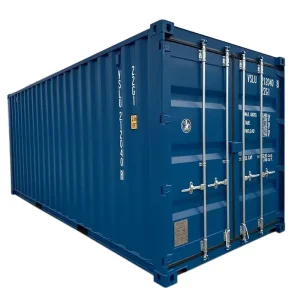
Maritime carriage demands structural integrity capable of enduring continuous 9-high fully loaded stacking (over 216,000 kg total gross vertical load) under intense sea swell dynamics, transverse racking stresses, and severe cyclic salt spray.
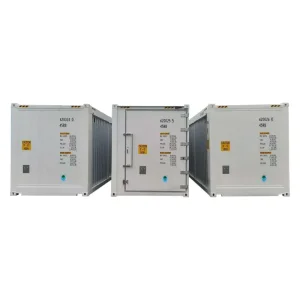
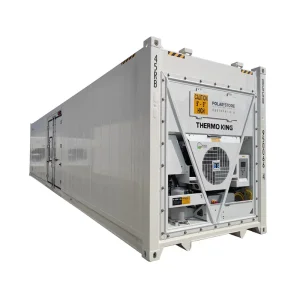
Global pharmaceutical batches and high-value agriculture require zero-drift thermal isolation. We engineer active reefer solutions equipped with integrated Carrier, Thermo King, or Daikin digital scrolling compressors.
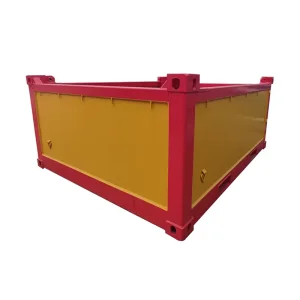
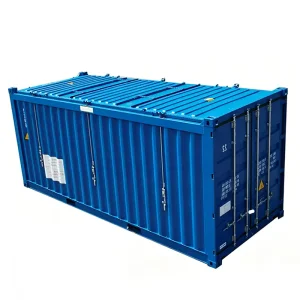
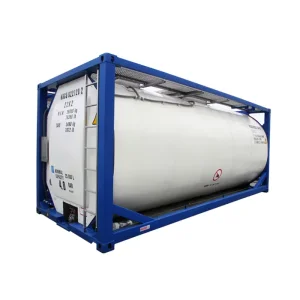
Built exclusively for hostile maritime zones (North Sea, Gulf of Guinea), offshore baskets, half-height open-tops, and offshore tank frames are engineered to withstand extreme dynamic shock loads.
Combining four decades of container structural craftsmanship since 1983 with cutting-edge robotic assembly lines, digital twin metallurgy simulations, and direct seaport connectivity.
Direct strategic joint procurement with premier steel groups (Baosteel, Angang) ensures verified chemical compositions, continuous availability of JIS G3125 SPA-H corten, and absolute price hedging for large-scale enterprise contracts.
6-axis multi-pass robotic welding systems ensure flawless penetration depth on structural side-panels, lower side rails, and corner fittings, eliminating human fatigue variance and guaranteeing microscopic weld seam porosity under 0.01%.
Fully enclosed pre-assembly steel shot-blasting stations stripping hot-rolled coils to Swedish Standard Sa 2.5 profile roughness, providing the pristine anchor substrate essential for ultra-durable paint adhesion in aggressive coastal saline zones.
Our production super-centers sit inside 100 kilometers of the Port of Tianjin and Eastern seaboard gateways, drastically reducing secondary inland transport emissions, cutting drayage demurrage, and accelerating vessel departure timelines.
The transition from passive steel freight boxes to cyber-physical IoT hubs is accelerating. Here is how CIMIC engineers next-generation intelligent intermodal units.
Autonomous edge trackers integrated directly within the corner post cavity or reefer controller. Featuring multi-carrier eSIM and low-earth orbit (LEO) satellite failover, providing non-stop geolocation, ambient humidity, continuous vibration/G-shock telemetry, and instant door-opening alerts without battery replenishment for over 7 years.
Next-generation passive cold-chain engineering utilizing latent thermal energy storage materials engineered with bio-based PCMs. Enables perishable pharmaceutical payloads to maintain stable +2°C to +8°C or -20°C cryogenic baselines for up to 120 hours without external diesel gensets or electrical plug-in power, drastically reducing transport emissions.
Strategic deployment of high-strength, micro-alloyed ultra-thin steels combined with carbon-fiber reinforced polymer (CFRP) roof bows and insulated flooring. Achieves tare weight reductions exceeding 15% (up to 480 kg per 40ft High Cube), directly expanding legally allowable cargo payload limits and saving fuel during inland hauls.
Purchasing container fleets based purely on initial Capex represents an outdated operational model. True logistical profitability is won through longevity, thermal efficiency, lower tare, and high secondary market liquidity.
| Evaluation Parameter | Standard Low-Cost Fabricators | CIMIC OEM Heavy-Duty Standard | Enterprise Operational Impact |
|---|---|---|---|
| Base Steel Metallurgy | Commercial Grade Carbon Steel (Q235) | JIS SPA-H Anti-Corrosive Corten Steel | Triples atmospheric corrosion resistance, extending working fleet life from 7 to 20+ years. |
| Reefer Foam Density | 28 - 32 kg/m³ (Prone to moisture absorption) | 40 - 42 kg/m³ High-Pressure Cyclopentane | Cuts reefer unit electrical power consumption by 22%, saving thousands per transpacific voyage. |
| Weld Integrity & QA | Manual spot welding, selective batch sampling | Robotic continuous welding, 100% NDT inspection | Guarantees zero racking twist under extreme 9-high dynamic stacking in violent weather. |
| Marine Protective Coatings | 2-Coat alkyd resin system (60-80 μm) | 3-Coat Zinc-Rich Epoxy + Polyurethane (120-160 μm) | Eliminates structural re-blasting and mid-life rust repairs; lowers maintenance costs by 65%. |
| Certification Documentation | Self-declared factory test certificates | Bureau Veritas (BV), ABS, DNV GL, CSC Plates | Unrestricted global customs clearance, rapid financing approval, and peak secondary resale value. |
Every single container leaving our production bays carries documented, tamper-proof accreditation accepted by customs authorities, port operators, and marine surveyors worldwide.
All dry, open-top, and refrigerated containers are delivered with a valid stainless steel International Convention for Safe Containers (CSC) safety approval plate, certified by Bureau Veritas (BV) or Lloyd's Register. This verifies maximum permissible gross weight (R), stacking capability (e.g., 216,000 kg), and transverse racking test ratings.
Through our established depot alliances across major Chinese transit hubs (Tianjin, Qingdao, Shanghai, Ningbo, Shenzhen), buyers can arrange immediate empty unit pickup, one-way leased positioning, or direct SOC (Shipper Owned Container) lading without enduring factory floor backlogs.
All locking gear assemblies, hinge pins, reefer controllers, and floor planking adhere strictly to universal ISO 668 and ISO 1496 specifications. This ensures replacement wear parts can be sourced off-the-shelf in Rotterdam, Houston, Durban, or Singapore without requiring proprietary manufacturing tooling.
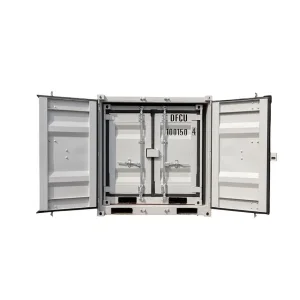
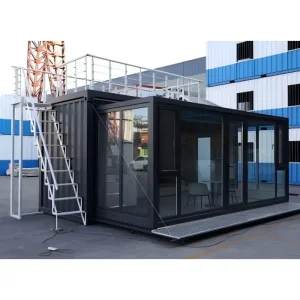
Explore our heavy-duty offshore solutions, hanging meat deep freezers, second-hand certified maritime reefers, and modular steel architectural units manufactured under tight OEM/ODM contracts.
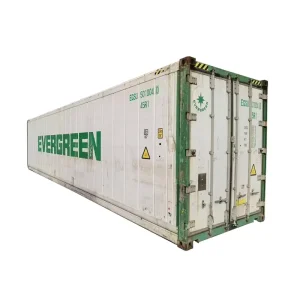
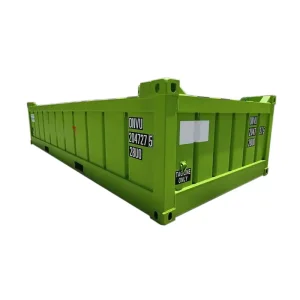
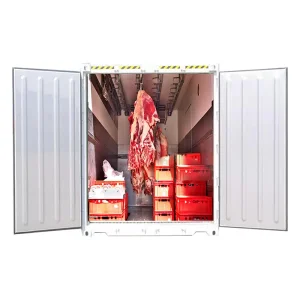
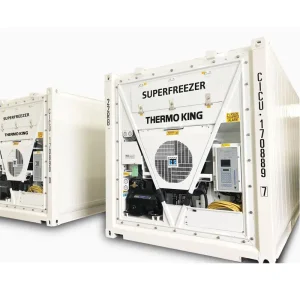
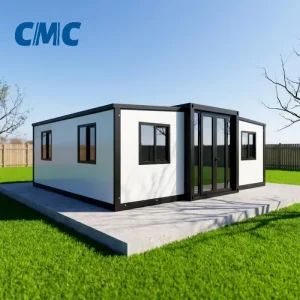
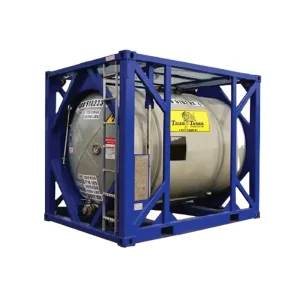
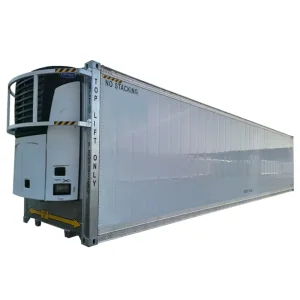
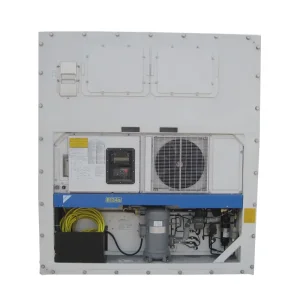
In-depth technical answers addressing dimensional tolerances, refrigeration machinery integration, certification verification, and custom engineering boundaries.
Our standard intermodal, insulated, and refrigerated lines are built in standard 10ft, 20ft standard, 20ft high-cube, 40ft standard, and 40ft high-cube (9ft 6in external height) formats. Furthermore, our OEM engineering team manufactures customized non-standard units including 45ft pallet-wide, 53ft domestic intermodal, half-height open-tops (4ft 3in height for dense minerals), and multi-door configurations (dual-end double doors, side-opening full-length doors, and heavy-duty roll-up shutters) tailor-engineered per industrial project drawings.
We supply, install, and calibrate world-standard refrigeration machinery from Carrier (such as PrimeLINE® with digital scroll and Thinline series), Thermo King (Magnum PLUS® offering temperatures down to -40°C), and Daikin (Zestia with DC inverter technology). We also engineer ultra-low deep freezer units capable of maintaining -60°C for specialized tuna and pharmaceutical sashimi-grade freight. Buyers receive full machinery commissioning logs and factory pre-trip inspection (PTI) certificates prior to export.
CIMIC holds ISO 9001 (Quality Management), ISO 14001 (Environmental), and ISO 45001 (Occupational Health) facility certifications. Units intended for sea transport carry an internationally validated CSC Safety Approval Plate issued under the inspection of Bureau Veritas (BV) or Lloyd's Register. For offshore assets, full structural compliance under DNV GL ST-E271 (DNV 2.7-1) and EN 12079 is documented with comprehensive NDT, material test reports (MTR 3.1), and dynamic sling pull-test certificates.
An active refrigerated container (reefer) features a powered electro-mechanical compressor and ventilation cooling circle that actively absorbs internal heat and maintains precise setpoints between -35°C and +30°C, requiring 380V/440V 3-phase power. An insulated container (thermal box) relies entirely on thickened rigid polyurethane or vacuum insulation panels (VIP) to passively restrict heat transfer without requiring external power, making it an economical choice for short sea feeder routes or stable ambient cold warehousing.
Our second-hand inventory comprises units retired from major global shipping lines and container leasing fleets, positioned across Chinese deep-water ports (Tianjin, Qingdao, Shanghai, Ningbo). Each used unit undergoes a 7-point structural evaluation checking floor integrity, corner post alignment, door seal weather-tightness (Cargo Worthy / IICL-5 standard), and zero light infiltration. For second-hand reefers, our certified technicians execute full electronic Pre-Trip Inspections (PTI) to verify compressor pressure and electrical components before release.
For standard in-stock 20ft and 40ft dry cargo or reefer units, the MOQ is 1 unit with immediate depot release within 48 to 72 hours. For bespoke OEM/ODM engineered containers requiring custom structural molds, specialized interior partitioning, electrical installations, or unique corporate color coating systems, initial production cycles average 20 to 35 calendar days with flexible sample batch MOQs determined during engineering design review.
From specialized cargo geometry calculations and finite element stress analysis (FEA) to intermodal shipping route optimization, Tianjin Cimic Imp&Exp Co., Ltd. provides comprehensive engineering and export assurance.
