Explore custom engineered ISO container solutions manufactured to BV, DNV, and classification society performance criteria.
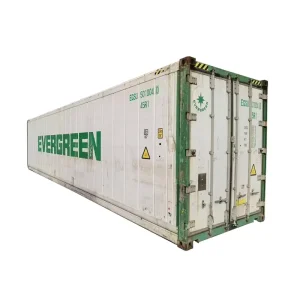
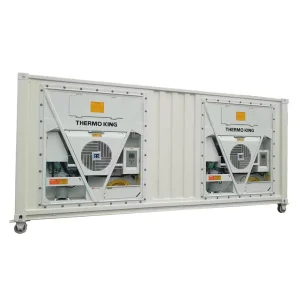
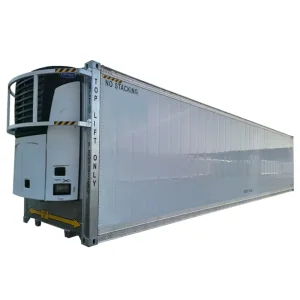
The transition from stationary ammonia-based cold storage facilities to dynamic, modular blast freezing infrastructures.
Modern aquaculture and poultry processors eliminate cold chain degradation by deploying localized blast freeze capacity directly at harvest landing sites and regional processing nodes, dropping core temperatures to -18°C within hours.
Global import frameworks (FDA FSMA, EU Regulations EC 852/2004, HACCP) mandate rapid transition through the critical crystallization zone (-1°C to -5°C) to prevent extracellular ice macro-crystals that damage cellular integrity.
Factory-engineered containerized units avoid the multi-year permitting cycles, expensive civil engineering work, and real-estate commitments required by fixed blast chillers, allowing rapid reallocation based on seasonal demand.
A rigorous industrial perspective into the sub-assemblies powering heavy-duty pull-down performance.
| Sub-System | Technical Blueprint & Materialization | Thermodynamic Operational Advantage |
|---|---|---|
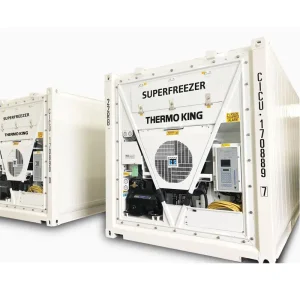
| Refrigerant Propulsion | Semi-hermetic two-stage screw or scroll compressors (Carrier, Bitzer, Thermo King architectures). | Ensures high volumetric efficiency at extreme compression ratios; limits discharge temperatures during continuous deep freeze cycles. |
| Air Velocity Dynamics | Heavy-duty backward-curved axial fans providing static pressure up to 250 Pa with uniform laminar floor-to-ceiling flow. | Breaks boundary layer thermal resistance across bulk-loaded product crates, preventing localized warm spots and assuring batch consistency. |
| Thermal Enclosure | High-pressure injected cyclopentane-blown polyurethane foam (100–120mm core; density 42–45 kg/m³) clad in food-grade SUS304. | Thermal conductivity λ ≤ 0.020 W/m·K. Eliminates thermal bridging, controls defrost cycling, and complies with sanitary washing procedures. |
| Defrost Thermodynamics | Intelligent reverse-cycle hot gas defrost augmented with sequenced electric sheath elements and timed drain-pan tracing. | Reduces defrost cycles to under 20 minutes; curtails ambient chamber heat ingress and protects payload integrity. |
Engineered cold-storage answers addressing bespoke commercial friction points across international trade lanes.
Immediate vessel-side deep freezing of high-value species (tuna, salmon, cephalopods) to -35°C to arrest lipid auto-oxidation, eliminate enzymatic degradation, and safeguard sashimi-grade tissue structures.
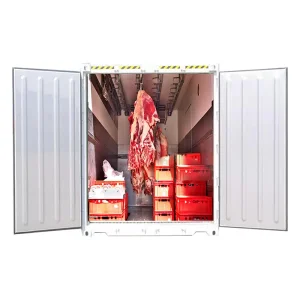
Reinforced ceiling overhead track systems (hanging meat architectures) handle carcass payloads without structural deformation, managing dynamic carcass outgassing and thermal inertia during high-throughput slaughter cycles.
Controlled batch cooling for soft fruits and berries. Rapid micro-environment pull-down arrests post-harvest respiration curves, retaining cell firmness and preventing rot in transit.
Validated cryogenic configurations holding cold temperatures down to -40°C. Engineered with redundant backup dual refrigeration systems and continuous cloud-integrated data recording for regulated biologics.
Built under audited management systems and classification society regimes to guarantee safety and compliance worldwide.
Every structural shell undergoes testing for stacking, transverse racking, longitudinal shear, and lifting points in accordance with ISO 1496-2. Units carry a valid CSC (Container Safety Convention) safety approval plate for global rail, vessel, and truck intermodal transit.
Fully compliant with EU F-Gas regulations and US EPA SNAP requirements, our systems use ultra-low GWP synthetic options and natural refrigerants (R452A, R454A, CO2 cascades) paired with variable-frequency drive (VFD) power trains for minimized carbon intensity.
Prior to port dispatch, units undergo an automated multi-stage PTI verification run: pressure leak detection, electrical safety stress tests, sensor calibrations, defrost validation, and a full load pulldown ramp-down recording test.
Targeted enhancements driving efficiency, connectivity, and performance across future product generations.
Integrated low-earth-orbit satellite transceivers and 5G modems send real-time cabinet telemetry (core probe temperatures, vibration indices, suction/discharge pressures, and amp draws) to enterprise cloud dashboards for automated failure prediction.
Next-generation prototypes combine rigid PU cores with micro-porous silica aerogel vacuum insulation panels (VIP), yielding up to a 38% decrease in heat ingress for the same internal volumetric envelope.
Emerging ODM integrations pair high-frequency acoustic emitters with sub-zero air streams. High-frequency vibrations initiate controlled nucleation, forming micro-fine ice crystals that leave cell membranes intact for minimal drip loss.
Explore our specialized intermodal conversions, offshore platforms, and dry modular containment lines.
Direct technical answers to common integration, deployment, and performance questions.
