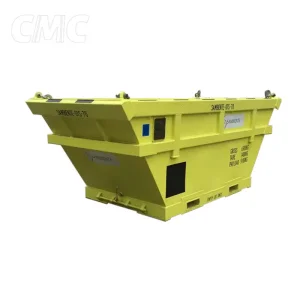
Explore high-precision specialized containers, portable chemical tanks, and climate-controlled equipment manufactured for international regulatory adherence.
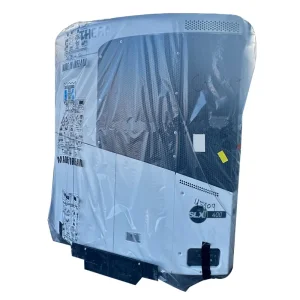
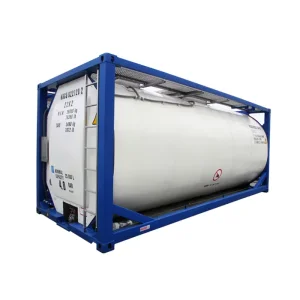
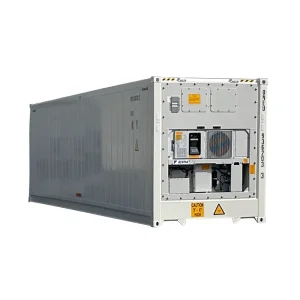

Rigorous regulatory frameworks, the explosion of global lithium-ion logistics, and expanding petrochemical corridors have reshaped the manufacturing mandate for dangerous cargo hardware.
International maritime logistics operate under stringent regimes such as the International Maritime Dangerous Goods (IMDG) Code, ADR/RID for European ground transport, and 49 CFR in North America. Modern hazardous material units must be designed with redundant physical security to neutralize marine disaster risks, thermal spikes, and corrosive punctures.
The worldwide transition toward electric mobility and stationary Battery Energy Storage Systems (BESS) has led to exponential demand for Class 9 dangerous goods containers. Thermal runaway containment, blast mitigation panels, and active gas scrubbing systems are now baseline engineering requirements for transit and battery storage.
Global supply chains require multimodal hazardous logistics that seamlessly transfer from deep-sea container vessels to rail cars and last-mile trucks. High-tensile Corten-A steel architecture combined with standardized twist locks eliminates transloading risks while protecting fragile or reactive chemical loads across complex trade routes.
Different hazmat cargo types present distinct thermodynamic, corrosive, and explosive risks. Our manufacturing lines customize physical dimensions, bund capacities, and alloy compositions according to UN Hazard Classes.
| UN Hazard Class | Primary Cargo Material | Recommended Container Type | Structural Safety Baseline | Compliance Rating |
|---|---|---|---|---|
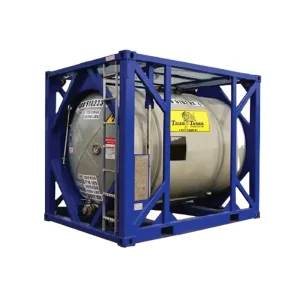
| Class 2 (Gases) | LNG, Ethylene, Industrial Nitrogen, Liquid Argon | T75 Cryogenic ISO Tank, Vacuum-Insulated Reefer | Double-walled austenitic stainless steel (304/316L), multi-layer vacuum insulation, emergency thermal release valves | ASME VIII / ADR |
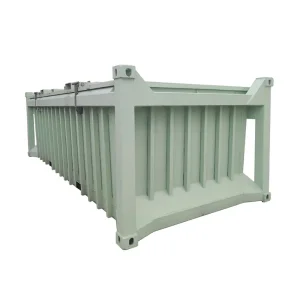
| Class 3 (Flammable Liquids) | Solvents, Fuels, Resins, Flammable Paints | 20ft / 40ft Bunded Dangerous Goods Side-Open Box | 110% volume retention spill sump, non-sparking zinc/aluminum mesh flooring, ATEX-certified passive/active ventilation louvers | IMDG / AS 1940 |
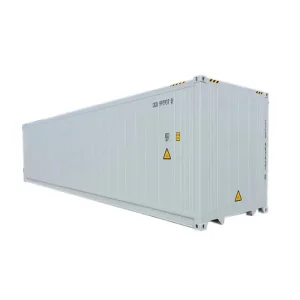
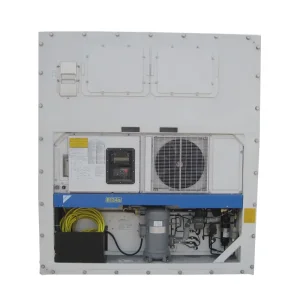
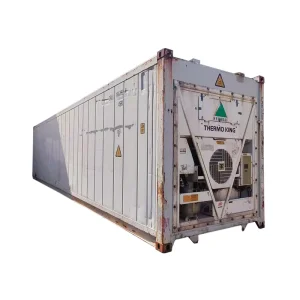
| Class 4 & 5 (Reactive Solids / Oxidizers) | Phosphorus, Sodium, Organic Peroxides, Fertilizers | Active Temperature-Controlled Reefer Container | Thermal insulation (thickened polyurethane foam), continuous temperature data loggers, spark-proof interior wiring, Daikin/Carrier units | CSC / BV Marine |
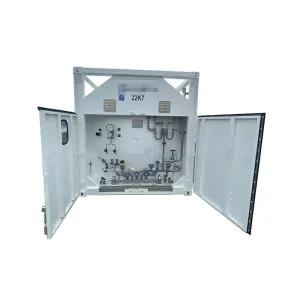
| Class 8 (Corrosives) | Sulfuric Acid, Hydrochloric Acid, Industrial Caustics | T11 / T14 ISO Tank Containers with PTFE/FEP Liners | Corrosion-proof fluoropolymer lining, rupture disc assembly, sealed valve spill enclosures with top discharge mechanism | UN Portable Tank |
| Class 9 (Miscellaneous & Lithium) | EV Battery Packs, Lithium Cells, Chemical Waste | Custom BESS Dangerous Goods Enclosure & Heavy Carrier | Reinforced base corrugation, thermal runaway barrier walls, gas venting dampers, integrated fire extinguishing pipe manifolds | DNV / ISO 1496 |
Our manufactured units perform reliably under harsh offshore ocean winds, deep inland continental freeze cycles, and demanding petrochemical processing yards.
Offshore operations in the North Sea, Gulf of Guinea, and Southeast Asian waters face dynamic wave-induced stress and high saline corrosion. We engineer DNV 2.7-1 certified offshore dry cargo containers, silt baskets, and chemical transport tanks that safely withstand crane hoisting in rough sea states (Sea State 6).
Modern chemical production clusters in Western Europe, the Middle East, and North America depend on ISO tank and side-open dangerous goods containers as modular storage buffers. Rather than constructing permanent fixed tanks, facilities utilize certified mobile units equipped with built-in spillage collection basins.
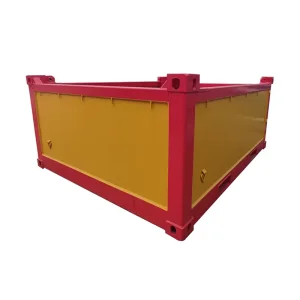
For remote extraction sites across Australia, South America, and Central Asia, the transport of cyanide, extraction acids, and liquid industrial gases requires rock-solid mechanical reliability. Our T75 cryogenic tanks and half-height ore containers guarantee containment during long haulage on unpaved roads.
Tianjin Cimic Imp&Exp Co., Ltd. (CIMIC Group) combines 40+ years of manufacturing experience with strategic deep-water port proximity to deliver comprehensive hazardous container projects.
We manufacture structural frames and external corrugated cladding exclusively with high-strength Corten-A weathering steel. This alloy forms a stable, protective oxidation barrier when exposed to ambient atmospheric moisture, preventing progressive rust penetration and ensuring high structural integrity over decades of service.
Every hazardous goods container manufactured in our Tianjin and Suzhou yards undergoes rigorous non-destructive testing (NDT), including 100% radiographic or ultrasonic examination of primary pressure welds, hydrostatic pressure trials up to 1.5x design pressure, and air-tightness examinations verified by third-party classification societies.
Located approximately 100 kilometers from northern China’s major maritime shipping gateways, our facilities eliminate inland drayage delays for out-of-gauge (OOG) and heavy chemical equipment. Rapid customs processing, direct factory-to-berth transfers, and established sea freight routes ensure predictable delivery timelines for overseas clients.
The future of hazardous cargo containment relies on cyber-physical integration: embedded IoT telematics, early runaway detection sensors, and passive thermal isolation barriers.
Next-generation dangerous goods units feature low-power satellite and cellular transceivers linked to internal sensor clusters. Operators can continuously monitor real-time interior pressure, core ambient temperature, vapor concentrations (VOCs), and dynamic shock impacts across global transits.
To safeguard temperature-sensitive Class 4 and 5 hazardous compounds during prolonged journeys without continuous power, our research and development team incorporates nano-porous silica aerogel paneling and Phase Change Materials (PCMs) to dramatically extend passive temperature hold times.
For large lithium-ion battery energy storage containers (BESS), modern designs deploy ultra-fast deflagration venting systems. Calibrated rupture panels relieve pressure waves within milliseconds of gas buildup, venting combustible fumes away from ship superstructures and personnel corridors.
Authoritative answers to critical engineering, safety certification, and design questions faced by procurement teams, logistics directors, and hazardous materials handlers.
Standard dry shipping containers feature wooden plank or marine plywood flooring, unvented interiors, and single-wall perimeter boundaries. Certified dangerous goods containers incorporate an internal continuous welded steel bund sump (providing 110% spillage containment of primary vessels), raised removable galvanized grating floors, spark-resistant aluminum accents, non-combustible insulation, and upper and lower louvered ventilation ports to evacuate dangerous vapors.
Dangerous goods containers must hold a valid CSC (International Convention for Safe Containers) safety approval plate and certification under the IMDG Code. Depending on the exact cargo, they must also satisfy ISO 1496 (Freight Containers Series 1), ASME Boiler and Pressure Vessel Code (Section VIII) for portable tanks, and approvals by recognized classification societies such as Bureau Veritas (BV), Lloyd’s Register (LR), or DNV.
Offshore containers are engineered to withstand severe dynamic mechanical shocks and acceleration loads experienced during offshore crane transfers in open seas. They require specialized high-impact structural steel grades tested at -20°C, fully welded primary lifting pad eyes directly integrated into corner structures, permanent sling sets, and strict non-destructive testing (magnetic particle and ultrasonic) across all structural welds.
Because CIMIC operates flexible manufacturing cells alongside high-volume continuous lines, custom OEM/ODM dangerous goods containers can be produced with MOQs as low as 1 to 2 units for highly customized builds (such as BESS enclosures or specialized ISO tanks). Standard lead times range from 30 to 45 business days depending on raw material specifications, internal lining choices, and external classification society witness testing schedules.
Explore heavy-duty bulk carriers, side-open dangerous chemical boxes, thickened insulated shells, and precision cooling units engineered for international logistics routes.